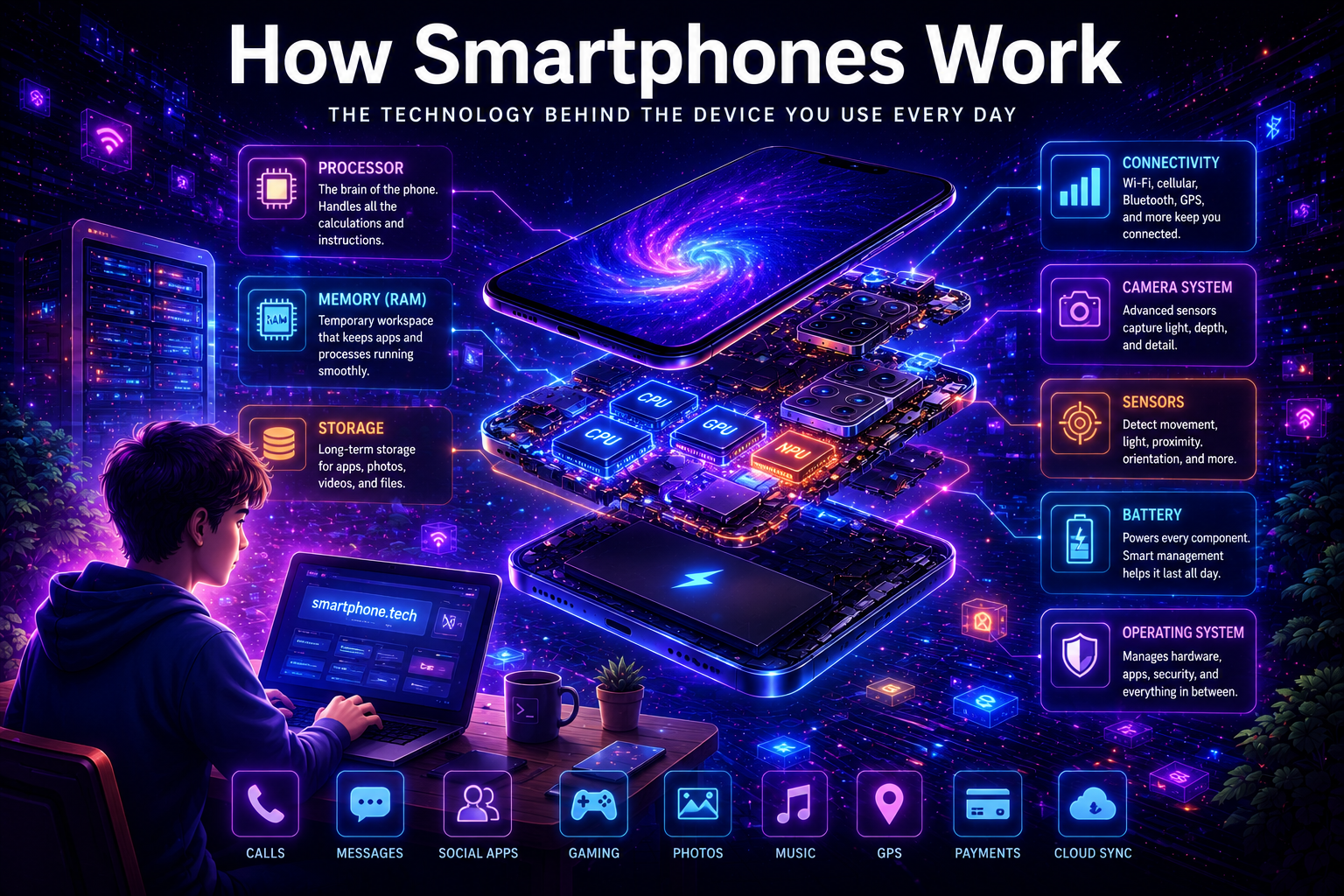
How many times do you unlock your phone every day? Probably a lot. Did you ever wonder what actually goes behind the glass? An application starts instantly; a message is delivered immediately across the globe, you are able to record videos, navigate and use AI tools from your phone!
It looks easy. But, in reality, it is not.
Nowadays smartphones are one of the most advanced devices created by mankind. All this magic happens because of an ecosystem of processors, memory systems, sensors, software, and wireless communication that work simultaneously.
A Computer That Fits in Your Pocket
A smartphone in reality is a computer.
In contrast to old devices that could do only one task at a time, phones perform dozens of tasks simultaneously. For example, a smartphone plays music, updates your location, and receives messages while running apps.
To be able to do that, smartphones have special parts.
Think about smartphones not as one device, but as a team.
The Brain: CPU and GPU
First of all, there is a CPU – a central processing unit of a phone.
It is responsible for any command sent to the phone – it receives and executes it.
But a smartphone does not consist only of CPUs. Another important part of the phone is a GPU.
GPU is a Graphics Processing Unit. It takes responsibility of drawing and managing graphical interface. As it performs lots of commands simultaneously, it becomes highly effective for visual workload.
Nowadays, a modern smartphone also contains NPUs – Neural Processing Units. NPU is dedicated to executing artificial intelligence algorithms.
Memory vs Storage: Why They Are Not the Same
Another part of a smartphone that is very frequently confused are RAM and storages.
The main difference between these two parts is that RAM works temporarily and is a space where your active applications are stored. Thus, phones with a large amount of RAM usually operate fast.
On the contrary, a storage stores all your photos, messages, apps even after you turn off the phone.
The OS: Invisible Manager
Even powerful hardware cannot help your phone operate.
An operating system like Android or iOS serves as a manager who controls and coordinates other parts of the phone.
OS:
- distributes memory
- controls applications
- manages battery usage
- ensures security
- determines processes execution.
Without an operating system, hardware could do nothing.
Sensors: How Smartphone Knows Everything About the World Around
One of the most interesting features of smartphones is a great number of sensors that are included in the phone.
Accelerometer, gyroscope, GPS, microphone, camera, ambient light sensor, proximity sensor – these are examples of the sensors that your phone possesses.
All these devices are used to gather data, that in their complex interaction provide you with an illusion of an ideal environment. For example, if a screen orientation is changed, several sensors perform together.
Connectivity: What Makes a Phone Instantaneous
As the name suggests, a smartphone is connected to the Internet all the time.
The phone uses such protocols as WiFi, cellular, Bluetooth, and GPS.
By using several protocols, a phone chooses a protocol with the best performance.
Each image uploading, each text message, or video streaming depends on the work of a specific wireless connection.
Battery: Continuous Struggle Between Performance and Consumption
The most limiting factor of any smartphone is battery.
Any brighter screen, faster performance, higher frequency means higher consumption of energy.
For that reason, a phone is able to control and reduce its performance in order to extend battery life.
Conclusion
A smartphone seems to be ordinary only because it became a part of everyday life.
However, each smartphone combines computing, network, sensors, graphics, and software design.
The next time you unlock a smartphone, remind yourself how many billions of operations happen right under your palm.
Leave a Reply